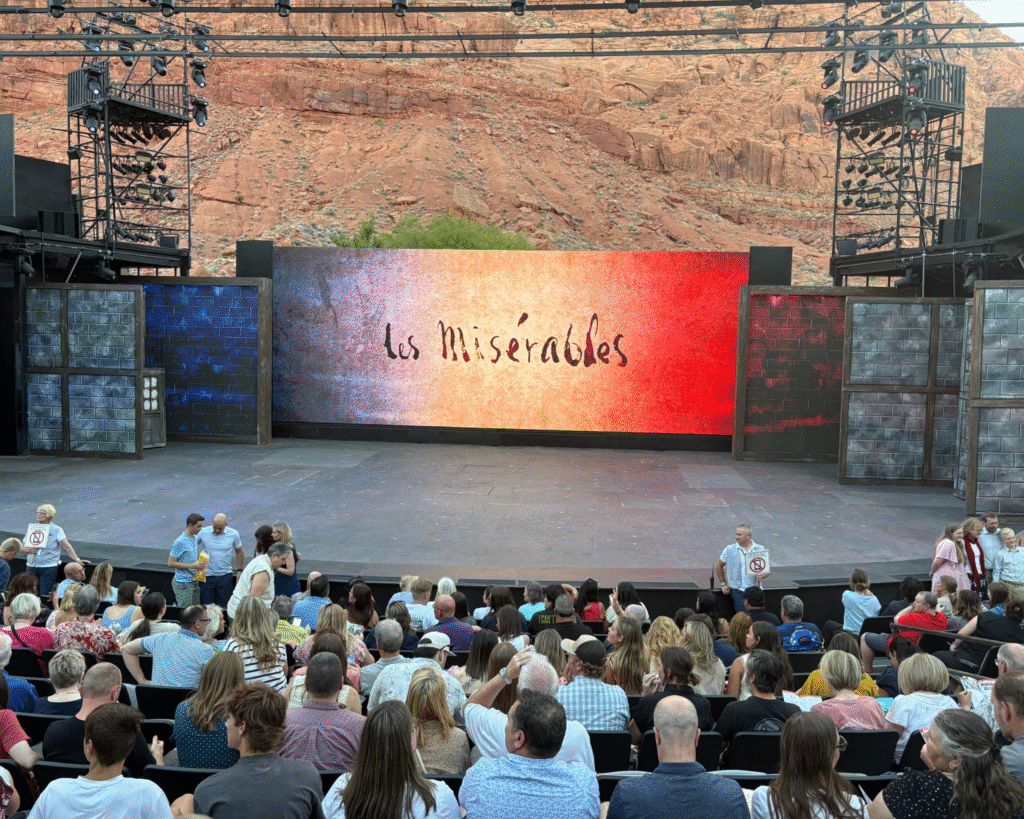
If you are familiar with Tuacahn Center for the Arts, then you already know that this is “Broadway in the Desert,” and it won’t surprise you that this summer’s Les Misérables is on every Broadway fan’s bucket list. With a world-class cast, stunning visuals, a powerful live orchestra, and one of the most beloved scores in musical theater history, this production delivers both spectacle and heart. Whether you are experiencing Les Misérables for the first time or returning to a favorite classic, Tuacahn has created an unforgettable evening of theater. Get your tickets now because they are going to sell every seat out!
One of my very favorite things in any Tuacahn show is when the stage opens up, and the desert landscape is part of a scene. So I was absolutely tickled when the screens retreated so that the prologue could take place in the red rock. There is so much delicious stage depth, and audiences meet two of the main characters right away: convict Jean Valjean (David Toole) and Javert (Randall Keith) on a magnificent horse, riding among the prisoners. This production has a world-class cast and the opening numbers establish this immediately. Toole’s emotional “Soliloquy” marks the turning point for Jean Valjean as he wrestles with the decision to continue living as an honest man or return to his former criminal identity. In this production, Toole captures Valjean’s inner conflict with remarkable intensity that he carries the entire show. The gradual shift from fear and uncertainty to determination is reflected not only in his powerful vocals but also in his physical presence on stage. The song effectively establishes Valjean as a complex character whose struggle for redemption drives the rest of the musical. Stephen Diaz, as the Bishop of Digne warmly reminds us that grace, generosity, and forgiveness can change lives forever.
Although the opening scenes establish the power of grace to change a life, Fantine’s story reminds us of the terrible cost when compassion is absent. Her descent into poverty and despair culminates in one of the musical’s most iconic numbers, “I Dreamed a Dream.” Mindy Smoot Robbins devastatingly portrays Fantine’s heartbreaking reflection on how her hopes for love and happiness have been destroyed. Robbins delivers the song with emotional vulnerability that makes Fantine’s suffering feel deeply personal. Her expressive phrasing and control of the song’s quieter moments allow the audience to connect with the character’s despair. Rather than relying solely on dramatic vocals, she conveys the pain of a woman whose dreams have slowly slipped away. Along with the vocals, the lighting design (Rob Siler) and Video Design (Gabriel Aronson) add beautiful imagery to match the rich vocals. The video animations flow in and out like watercolor or ink on wet paper. Fantine’s moment was perfectly illustrated and there were many other gorgeous moments throughout the show.
As Fantine’s circumstances worsen, her daughter Cosette falls into the hands of the Thénardiers, a pair of opportunists whose greed stands in sharp contrast to the generosity shown by the Bishop earlier in the story. Their introduction shifts the tone dramatically from tragedy to comedy, to the delight of the audience, in “Master of the House.” As the dishonest innkeepers Thénardier (Zach Berger) and Madame Thénardier (Janna Cardia) entertain their guests while secretly exploiting them, the performers bring energy and humor to the stage. Both Berger and Cardia navigate the rapid shifts between outrageous comedy and outright villainy with remarkable finesse (Please come back and see her as Janna Cardia as Dory!). The chemistry and comedic timing between Berger and Cardia (and even little Éponine, played by Betty Jorgensen, Kassie Nielson, and Lena White) keep the audience in stitches, and the lively choreography adds to the song’s chaotic atmosphere. This show has a great ensemble, so make sure you are watching all the different stories that are playing out all over the stage. There is so much going on!
After Valjean rescues Cosette from the Thénardiers, the story leaps forward several years. While Cosette grows up under Valjean’s protection, Javert (Randall Keith) remains obsessed with tracking down the former convict he believes has escaped justice. That unwavering pursuit sets the stage for Javert’s powerful solo, “Stars.” Randall Keith’s commanding baritone performance highlights the character’s rigid worldview and sense of duty. Standing alone on stage, he projects both authority and isolation, emphasizing Javert’s inability to understand moral ambiguity. The song provides valuable insight into the character’s motivations and helps establish him as a worthy counterpart to Valjean. This was another moment made even more atmospheric by lighting and video design.
Yet Paris is on the brink of change. While Javert places his faith in law and order, a group of idealistic students led by Enjolras (Davey Burton MidKiff) dream of a more just future for France. Street-wise Gavroche (Jayven Cook and Emmitt KLC) brings infectious energy and fearlessness to the cause. The ensemble’s passion and determination come alive in “Do You Hear the People Sing?,” one of the musical’s most recognizable anthems. The number showcases the strength of Tuacahn’s ensemble, as voices join together in a stirring call for unity and revolution. The students’ infectious energy and unwavering conviction create a thrilling sense of momentum that carries through the rest of the production, while also introducing the political movement that will eventually shape the fates of many of the show’s characters.
As the story expands beyond the rivalry between Valjean and Javert, audiences are introduced to a new generation of dreamers. When Marius (J.T. Wood) encounters Cosette (Rachel Schoenecker), the connection is immediate, but the moment is complicated by Éponine (Kelsey Lee Smith), who secretly loves him herself. This emotional triangle provides the backdrop for one of the musical’s most beloved romantic numbers: “A Heart Full of Love.” The performers created a warm and believable sense of youthful affection that contrasted with the hardships surrounding them. The three voices blended beautifully, creating a hopeful and uplifting moment in the musical. Schoenecker’s crystalline soprano pairs nicely with Wood’s warm tenor. At the same time, Smith’s wistful vocals as Éponine add an undercurrent of sadness that hints at the emotional complications to come.
As Marius falls more deeply in love with Cosette, Éponine realizes that the affection she has long held for him will never be returned. The result is one of the musical’s most powerful moments, as she finally steps out of the shadows and tells her own story in “On My Own.” Kelsey Lee Smith delivered the number with sincerity and emotional depth, capturing both the character’s longing and her acceptance of reality. Her performance transformed a private moment of heartbreak into one of the production’s most memorable scenes. The combination of expressive vocals and genuine emotion makes the audience sympathize deeply with Éponine’s loneliness and sacrifice.
I won’t spoil the fate of Valjean, Javert, Cosette, Marius, Éponine, or the revolutionaries. Come and experience that journey for yourself. What I will say is that one of the greatest strengths of this production is its remarkable ensemble. Every member of the cast contributes to Director Sarah Hartmann’s rich tapestry of life on stage, creating stories within stories that reward audiences who look beyond the principal characters. Through carefully crafted movement, choreography (Ashley Martinelli), hair and makeup (Annie Hardt), and costumes (Ricky Lurie), each performer inhabits a distinct personality while collectively creating a believable community and a living, breathing Paris. One of the joys of Tuacahn’s repertory season is seeing these same performers transform from the world of Les Misérables into the colorful underwater adventure of Finding Nemo on alternating nights. Watching actors embody such dramatically different roles is a testament to their range, versatility, and talent. You simply have to see both productions to gain greater appreciation for the skill and artistry of this exceptional company!
Of course, a production as ambitious as Les Misérables depends on far more than its cast. The soaring score is brought to life by the outstanding live orchestra (directed by Christopher Babbage), whose musicians provide the emotional heartbeat of the show, while the sound design (Josh Liebert) ensures that every lyric and orchestral swell reaches the audience with clarity and impact. The scenic design (Clayton Dombach) transforms Tuacahn’s stage into nineteenth-century Paris, creating a world that feels both expansive and intimate. The set pieces that build the city are move and rotate to feel like you are winding down streets. From bustling city scenes to quiet moments of reflection, the set continually evolves to support the story. The bridge and the barricade are exquisite and create such a powerful tableau for the ensemble in the second act. Special recognition should also go to fight director Jason Paul Tate and fight choreographer Erica Bryce, whose work makes the show’s moments of conflict feel startlingly real. Staging battles on a theatrical stage is no small feat, yet the confrontations are executed with such precision and authenticity that the danger feels immediate and the stakes feel genuine. Together, these technical elements elevate an already powerful musical into a truly immersive theatrical experience.
Tuacahn Center for the Arts presents Les Misérables by Alain Boublil and Claude-Michel Schonberg, based on a novel by Victor Hugo
Tuacahn Amphitheater, 1100 Tuacahn Drive, Ivins, Utah 84738
Now – October 24, 2026, Performance dates and times vary
Tickets: $53-$144
Contact: 800-746-9882
Tuacahn Facebook Page