There is something quietly thrilling about watching history before it knows it is history. Million Dollar Quartet invites audiences into that rare in-between moment, when four young musicians—Elvis Presley, Johnny Cash, Jerry Lee Lewis, and Carl Perkins—shared a cramped recording studio and unknowingly reshaped American music.
Rather than imposing a traditional narrative, the show trusts the power of the music itself. What emerges is a portrait of ambition, ego, and artistry at the edge of explosion—a reminder that revolutions do not always arrive with speeches or manifestos. Sometimes, they arrive with a guitar riff, a pounding piano, and a room full of sound.
At its heart, however, the production is a tribute to Sam Phillips, the producer who recognized something extraordinary in four young performers and gave them the space to discover it. In celebrating Phillips, the show becomes a broader homage to teachers, coaches, and mentors—the people who listen closely, encourage risk, and help artists uncover their unique contribution to the music. It’s American rock and roll at the moment it learned how to roar.
Million Dollar Quartet is inspired by a real and largely accidental moment in music history: a December 1956 recording session at Sun Records that brought Elvis Presley, Johnny Cash, Jerry Lee Lewis, and Carl Perkins together in the same room. What survives from that day is not a polished album, but a loose, joyful jam of musicians playing for one another, chasing sounds and nostalgia rather than singles. And one incredible photograph.
The musical mirrors that spirit. Rather than constructing a traditional narrative arc, Million Dollar Quartet embraces a concert-style structure, allowing the songs to carry the storytelling weight. The result is a show less concerned with plot mechanics than with capturing a feeling: the restless energy of young artists on the brink of something bigger, guided by a producer who understood that discovery matters more than perfection.
Because Million Dollar Quartet lives or dies by its musicianship, the cast carries an unusually heavy burden of playing live the whole show. In this production, they rise to it with confidence and care. The performers are tasked not only with embodying some of the most recognizable figures in American music, but with doing so live, onstage, and without the safety net of imitation alone. What emerges is a balance of homage and individuality that keeps the performances feeling alive rather than museum-like.
Jerry Lee Lewis (Ian Fairlee), often the gravitational center of the evening, delivers both blistering piano work and uncontainable energy, turning each number into a high-voltage event. If you have never seen anyone play the piano backwards or upside down, you need to see this show! Elvis Presley’s (Sean Buckley) easy charisma and charm are an emotional counterweight, while Johnny Cash (Michael Potter) brings a grounded restraint that hints at the depth beneath the stoicism. Carl Perkins (Colin Summers) offers emotional intensity—his songs carrying the weight of artistic frustration and hard-earned craft.
Just as crucial to the evening’s success is Sam Phillips (Luke Darnell), whose presence grounds the chaos. Rather than functioning as a passive narrator, Phillips becomes the connective tissue of the show—listening closely, steering conversations, and creating the conditions for discovery. His performance reinforces the production’s central idea: that great music often begins with someone who knows when to guide and when to get out of the way.
Dyanne (Sarah Ellis) adds warmth and vocal contrast to the testosterone-heavy lineup, her appearances serving as welcome moments of tonal shift and emotional release. Meanwhile, the rhythm section—Fluke (David Sonneborn) on drums and Brother Jay (Isaac Ericksen) on bass—provides the steady backbone that allows the rest of the cast to take risks. Their musicianship is felt in every transition, making the ensemble feel less like a cast and more like a band sharing a single, charged room.
This cast has incredible, easy chemistry. The show succeeds when it feels less like four separate character studies and more like a band sharing space, listening, responding, and pushing one another forward. Backed by tight, responsive musicianship throughout, the production captures the rare thrill of watching performers not simply play songs, but actively make music together.
Under Keith Andrews’ direction, Million Dollar Quartet maintains forward momentum while allowing the music room to breathe. Andrews understands that the show’s power lies not in over-shaping the material, but in creating a framework where spontaneity feels possible and the musicianship remains front and center. That restraint pays off, particularly in a production that could easily tip into excess.
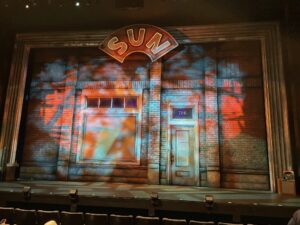
Adam Koch’s scenic design anchors the action in the familiar intimacy of Sun Records, establishing a space that feels both historically grounded and flexible enough to support a concert-style flow. Costume coordination by Faith Brown reinforces period authenticity without slipping into caricature, while Annie Hardt’s hair and makeup design subtly distinguishes each performer, helping character emerge through silhouette as much as performance.
Paul Black’s lighting design is especially effective, shifting fluidly between theatrical storytelling and full-fledged concert energy. In key moments, the lighting transforms the stage into a live music venue, inviting the audience to respond as they might at a rock-and-roll show. That immersion is supported by Eric Alexander Collins’ sound design, which balances clarity and volume, ensuring the music lands with impact without overwhelming the space. Music Director David Sonneborn holds the production together, shaping a cohesive sound that allows individual performances to shine while maintaining a unified musical pulse.
At its core, this production of Million Dollar Quartet is a celebration of sound, of collaboration, and of the moment when rock and roll was still finding its voice. Rather than interrogating its history, the show revels in it, offering audiences a front-row seat to the origins of music that has become deeply woven into American culture. The result is a production that succeeds most fully as a concert, inviting listeners to remember not just the songs themselves, but the thrill of hearing them for the first time.
That nostalgia is worn proudly and without apology. For longtime fans of early rock and roll, the evening feels like a joyful trip down memory lane; for newer audiences, it offers a lively introduction to the artists who helped shape the sound that followed. Million Dollar Quartet may not aim for narrative complexity, but it achieves something equally meaningful: a shared musical experience that honors the pioneers who started it all and reminds us why their music still matters.
Tuacahn Center for the Arts presents Million Dollar Quartet, book by Colin Escot and Floyd Mutrix, original concept and direction by Floyd Mutrix, inspired by Elvis Presley, Johnny Cash. Jerry Lee Lewis, and Carl Perkins
Hafen Theatre, 1100 Tuacahn Drive, Ivins, Utah 84738
January 30-March 7, 2026, Performance dates and times vary
Tickets: $40-$102
Contact: 800-746-9882
Tuacahn Facebook Page